
September 22, 2026
The U’s longest standing women’s philanthropic organization marks 30 years of impact
by Katie Zaun
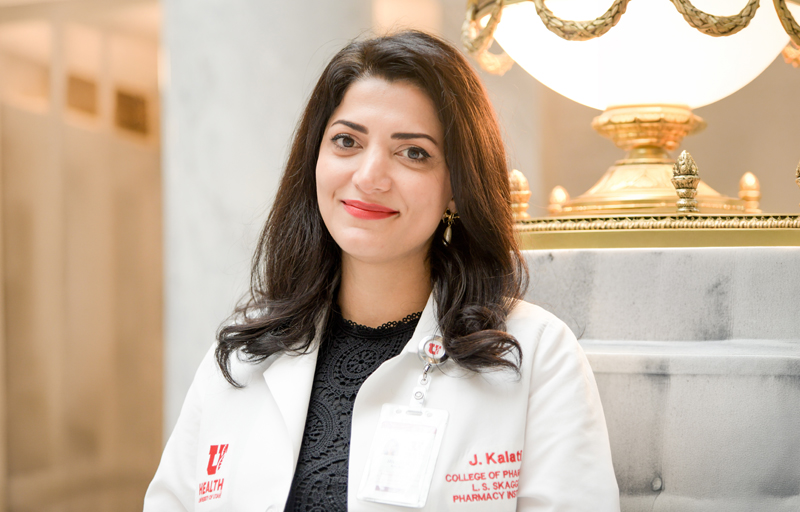
“Pharmacy school has been one of the most challenging journeys of my life—and one of the best decisions I ever made,” said Java Kalati, a fourth-year PharmD student at the University of Utah College of Pharmacy and a recipient of an Educational Resource Development Council (ERDC) scholarship. Kalati, born in Iran, is a mother of two whose path to pharmacy school has been anything but a straight line.
Taking care of her young children and her ill father—all while her family navigated the realities of living on a single income as she completed her degree—Kalati often questioned whether she belonged. But with the ERDC behind her, as well as her family, her mentors and preceptors, her PharmD cohort, and the Office of Student Affairs, she kept going, finding joy and a deep sense of purpose in listening to, educating, and advocating for patients in some of their most vulnerable moments.
“When an older patient managing multiple health complications and an intense treatment plan began looking forward to our weekly follow-up calls, or when a mother whose eyes filled with tears because we caught a medication error in time and her child received the correct dose. These moments reminded me exactly why I started the program,” she reflected.
Student Scholarships

Kalati is one of 30 students to receive funding this year from the ERDC, a philanthropic group of nearly 100 women leaders who are advancing University of Utah Health research and student scholarships through their collective giving. Originally founded in 1991, the group began giving in 1997 and has since contributed over $3 million to U of U Health—distributed across ten endowments valued at nearly $1 million; more than 375 research projects, academic initiatives, and clinical programs; and over 530 scholarships within the five colleges that make up U of U Health.
“These scholarships help students get over the finish line,” said Jonette Mangum, immediate past chair of the ERDC’s executive board.
Over the years, students have used these $5,000 to $7,500 grants to pay for tuition, as well as childcare, rent, transportation, and other basic needs. When balancing life and school stretches students thin, every dollar counts toward helping them achieve their goals.
Cutting-Edge Research and Program Investments

Within the last year alone, the ERDC has made substantial impact supporting a range of innovative projects, including dementia care through Medicare’s Guiding an Improved Dementia Experience Model, grief support provided by the College of Nursing’s Care Connections program, a pilot program designed to deepen public understanding of transformative research at the U in communities along the Wasatch Front, nutrition education through the College of Health’s Metabolic Kitchen, and a new specialty clinic for the early identification of hearing loss and dementia within the U of U Health’s Speech-Language-Hearing Clinic.
The group also backed a biochemistry lab at the U, led by renowned researcher Wesley Sundquist, PhD, Leo T. & Barbara K. Samuels Presidential Chair and distinguished professor of biochemistry. Sundquist’s bench research has led to a breakthrough in HIV prevention: a twice-yearly antiviral shot known as lenacapavir, with near-100% efficacy in preventing HIV. Because HIV continues to evolve and develop resistance to existing treatments, Sundquist’s lab is focused on studying the virus at critical stages of its life cycle with the hope of continuing to advance next-generation HIV therapies.
Research investments also extend to a potentially groundbreaking study on the human proteins linked to autism, led by PhD students in the College of Pharmacy, and to the work of Donna Cross, PhD, director of the Neuroimaging and Biotechnology Lab and an associate research professor investigating a new drug treatment for ALS.
This research would not have been possible without ERDC support. On behalf of the Neuroimaging and Biotechnology Lab, my students, as well as my patients with ALS, who may benefit in the future, I have the utmost gratitude,” Cross said.
Cross’s success could also revolutionize the treatment of other brain diseases, including Alzheimer’s and MS. And these projects only scratch the surface of the ERDC’s impact.
30 Years of Giving

What started as a 10-woman advocacy group is now the U’s longest standing women’s philanthropic organization, whose generosity reaches everyone from inspiring young people just getting their start to faculty nominated for a Nobel Prize. Today, eight of the 10 founding members are still involved, continuing to give of their time, talent, and treasure in service of the ERDC and U of U Health.
“I’m so impressed with the ERDC and the women involved, especially those who founded the group. They continue to be actively engaged in the mission, attend monthly meetings, and have given selflessly of their time and resources. It’s really an honor to carry the torch of goodwill and good deeds,” said Carol Firmage, current chair of the ERDC.
As the group approaches their 30-year anniversary celebration, Firmage and Mangum are in awe of not only their fellow members but also the wonderfully talented students and researchers they get to work with.
These people are absolutely impressive. The work that these doctors are doing, and to meet these students who are accomplishing so much—it’s inspirational,” Mangum emphasized.
Kalati is one of many of these inspirational people, and for her, the financial pressure the ERDC relieved her of provided time to breathe and focus on her desire to contribute to something bigger than herself.
“Making a difference does not always mean changing the whole world,” Kalati said. “Sometimes it simply means bringing light to the small part of the world that you can reach.”


